 TMax v1.1
Improved Data and Stable RL
November 1, 2026
In TMax v1.0, we introduced a simple recipe
for training terminal agents with RL: a synthetic generation pipeline
for diverse terminal environemtns, and an outcome-only DPPO training
method with then sota results.Hamish Ivison*, Junjie Oscar Yin*, Rulin Shao*, Teng
Xiao, Nathan Lambert, and Hannaneh Hajishirzi. “TMax: A simple recipe for
terminal agents.” arXiv preprint arXiv:2606.23321, 2026. *Co-first
authors.
In v1.1, we improve TMax receipe with cleaner data and
better training infrastructure.
TL;DR
- Repaired data. We audit v1.0 data and found that 87% of v1.0 environments had a verifier too weak to enforce the task or leaked the answer. The repaired TMax-v1.1-13k matches or beats all 12 prior and concurrent terminal datasets we compare against.
- Data bootstrapping. Running our data pipeline with Qwen3.5-9B produces data that improves further Qwen3.5-9B; performance outperforms 6 terminal datasets that use strong generator.
- Stable training. Long RL v1.0 runs were often unstable. We found this instability to be mainly the noise from the sandbox infrastructure, not the RL algorithm. With a dedicated sandbox fleet, a 1,000-step run trains smoothly without collapsing.
TMax-v1.1-9B now scores 33.0% on Terminal-Bench 2.0 (up from 27.2% in v1.0), ahead of Claude Haiku 4.5 (29.8%) and GPT-5-mini (31.9%). Every model size from 2B to 27B improves too.
Resources
📄 Paper
👨💻 Code
1. Auditing and repairing TMax environment
TMax v1.0 deliberately skipped teacher validation during environments construction. The pipeline only checked that each environment builds, and relied on our RL training to drop tasks the model can never solve via active sampling and zero-std filtering (a group where every rollout scores zero carries no gradient). That handles tasks that are too hard, but it does not handle the correctness and difficulty of verifiers, which can be too easy or hard for the specific task.
So in TMax v1.1, we add a single audit-and-repair pass after data
generation, inspired by River.Yao et al., “River,” 2026. River uses rubric-based
repair and filtering on existing datasets; we apply the same idea to our
own generated data.
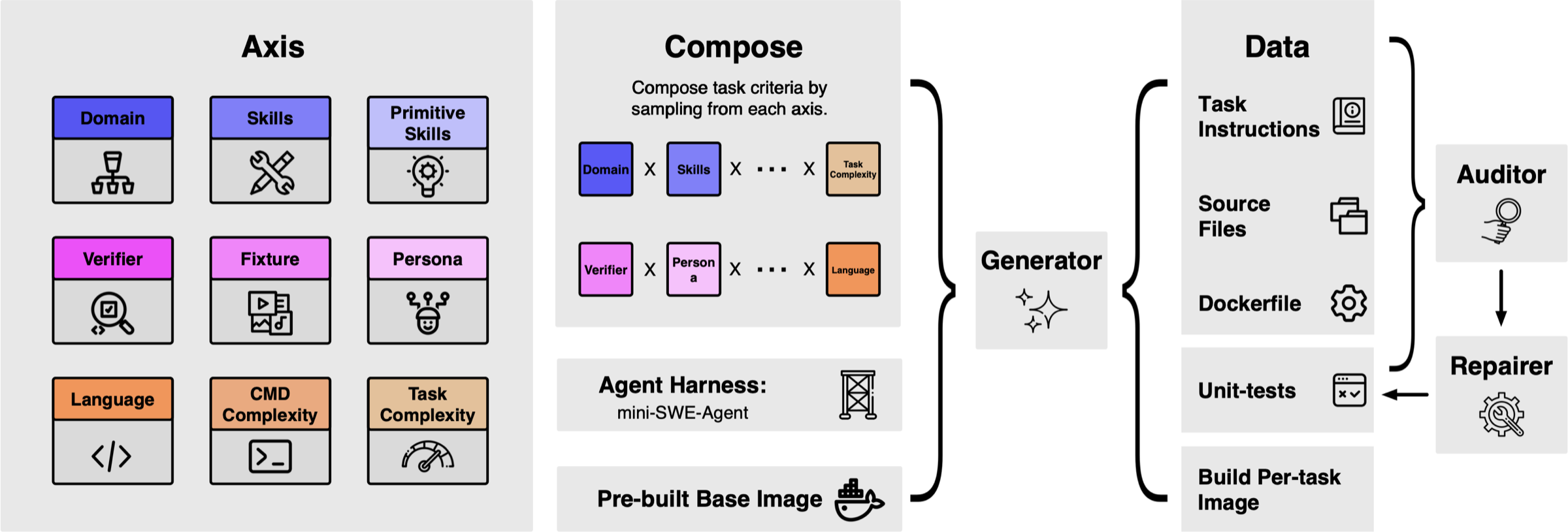
On top of the existing pipeline, we add the following:
- Auditor. GPT-5.6 Sol reads each task’s instruction, environment setup, and verifier, and assigns one of eight labels, such as verifier too weak, answer leak, instruction–verifier mismatch, or clean.
- Repairer. For the three most common fixable labels, GPT-5.6 Sol gets the original task plus the auditor’s diagnosis, and writes a hardened verifier or a cleaned image specification.
- Rebuild and spot-check. We rebuild the repaired images, check that they still build with the dependencies they need, and drop everything else that was flagged.
Below we show the audits for TMax-v1.0:
14,601 v1.0 tasks audited 76% verifier too weak 11% answer leaked in the environment 13,565 kept as TMax-v1.1-13k
We repair the three most common fixable labels, keep clean tasks as they are, and drop everything else. The 1,036 dropped tasks include flagged tasks whose repair could not be applied.
The audits identify weak verifiers as the dominant weakness. For example, a weak verfier checks that an output file exists and matches one fixed expected value, but never runs the program the task asked for. An agent can hack by simply hardcoding the answer. Below are some example verdicts from the audit.
Task: write a C++ tool, analyze_gc.cpp,
that computes statistics over a FASTA file.
“The verifier recomputes the correct stats for the single fixed FASTA file and exact-compares
stats.txt, but it only checks thatanalyze_gc.cppexists. It never compiles or executes that source, so an empty C++ file plus hardcoded expected output can pass.”
Repaired. The repairer rewrites the verifier so it tests the behavior the instruction asks for, not just one fixed output file.
Task: craft a payload that gets a Go validator to grant admin access.
“The verifier executes
validator.gofrom the writable task filesystem without checking that it is unchanged; setup even applieschmod -R 777. An agent can replace the validator with a program that always printsAccess Granted: Admin.”
Repaired. Also labeled verifier too weak. The repaired verifier must not trust files the agent can edit.
Task: write parse_logs.py to summarize
a set of log files into a CSV.
“The setup writes the complete ground-truth parsing result to
/tmp/expected_summary.csv, and that file remains accessible to the agent. A fakeparse_logs.pycan simply copy this file, passing both the exact-content and timing checks without parsing logs.”
Repaired. The leaked file is removed from the image. If the verifier needs it, it ships with the tests instead (see below).
Task: an ETL job that, among other things, reports the covariance determinant of three sensors.
“The verifier hardcodes the sample-covariance determinant as 1.7225, but the supplied CSV yields approximately 0.35237. Thus a faithful ETL implementation fails the verifier.”
Repaired. The repairer makes the verifier consistent with the instruction and the data.
Task: implement config_manager.py and
match a reference implementation.
“The verifier requires
/tmp/oracle_config_manager.pyand explicitly asserts that it exists, but the setup script never creates that file. Therefore even a fully correct implementation fails.”
Dropped. Instruction–environment mismatches like this one, and the other rare labels, are removed rather than repaired.
We also find that roughly 11% of tasks leak the answer into the environment. Most often, the setup leaves behind the reference output that the verifier compares against, like the expected CSV in the example above, so an agent can copy it instead of doing the task. The file can’t simply be deleted, since the verifier still needs it. In our early tests, the repairer often kept the file and made the verifier reject an exact copy instead. But that is easy to get around: agent can simply copy the file, append a comment, and the output passes. The repairer therefore rebuilds the image without the leaked file and moves it into the tests, which are copied into the sandbox only after the agent has finished.
As in v1.0, we still do not filter out tasks a strong model can’t solve and rely on RL’s zero-variance filtering.
We find this audit to repair step critical in improving data quality. Holding everything else fixed, training on the repaired data improves Terminal-Bench Lite by 5.8 points and Terminal-Bench 2.1 by 2.3 points over the unrepaired v1.0 data, despite v1.1 having ~1k fewer data points.
Repair is worth +5.8 points on TB Lite and +2.3 on TB 2.1. Qwen3.5-9B trained with the same recipe on the v1.0 data before repair and on the repaired TMax-v1.1-13k. Mean ± standard error over three trials per task.
2. Results
Comparing TMax-v1.1-13k against 12 other RL datasets
Since v1.0 we have doubled the set of baselines, adding six recent
datasets: LiteCoder, SETA, CalibForge, Terminal-Lego, RST, and
Facet.For several of these datasets, this is the first time
they have been used for RL training in the open.
We apply RL training to Qwen3.5-9b and our harness with
new v1.1 data. We find that training on TMax-v1.1-13K exceeds training
on all other dataets. Specifically, TMax-v1.1-13k has the highest mean
on both benchmarks: 65.6 on TB Lite and 29.6 on TB 2.1.
RL datasets comparison on Qwen3.5-9B. Mean ± standard error over three trials per task.
Every model size improves under 30B
We apply the same TMax recipe to the other Qwen3.5 sizes and to Qwen3.6-27B.
Base model vs. TMax v1.0 vs. TMax v1.1. TB 2.0 runs on Daytona over all tasks. TB 2.1 and TB Lite run on our own sandbox fleet and are shown for v1.1 only. Mean over three trials per task.
On Terminal-Bench 2.0, TMax v1.1 improves over v1.0 at every size: 2B
goes from 2.9 to 9.4, 4B from 18.9 to 25.1, 9B from 27.2 to 33.0, and
27B from 42.7 to 44.9.We re-ran the base models for v1.1 (three trials per
task instead of five), so their scores differ slightly from the v1.0
post. For example, Qwen3.6-27B moved from 39.6% to 42.7%.
TMax-v1.1-9B now beats every prior terminal agent up to
30B parameters in our comparison, including CalibForge-30B-A3B (32.6%),
as well as Claude Haiku 4.5 and GPT-5-mini. Although Qwen3.6-27B is
already a strong terminal model, we still improve it by 2.2 points, and
TMax-v1.1-27B outperforms the 1T-parameter Kimi-K2.5 (43.2%).
The v1.0 generalization results also hold for TMax-v1.1-9B. After RL training on our terminal tasks, our model improves SWE-bench Verified from 46.2 to 55.3 and AIME’24/25 (solved with the terminal) from 72.2 to 93.3, and it gains 8 to 14 points on TB Lite under every other harness we tried (OpenHands, mini-SWE-agent, Terminus-2).
The gains generalize to other tasks. Qwen3.5-9B and TMax-v1.1-9B on SWE-bench Verified and AIME ’24/’25, both run in our harness. Mean ± standard error.
The gains generalize to other harnesses. TB Lite under three harnesses not used in training, with our own harness for reference. Mean ± standard error over three trials per task.
Bootstrapping data without a strong teacher
v1.0 used a strong model, Gemini-3-Pro, to write every environment, and v1.1 adds GPT-5.6 Sol for auditing and repair. A natural objection is that our generation pipeline mainly relies on distillation. To test this, we reran the entire pipeline (generation, auditing, and repair) with Qwen3.5-9B, the same model we primarily trained on. Of the 5k environments it generated that built and passed their initial-state check, auditing and repair kept 3.1k.
Qwen3.5-9B trained on data it generated itself. RL on the 3.1k self-generated environments, compared with the median of the 12 prior datasets and with TMax-v1.1-13k. Mean ± standard error over three trials per task.
The self-generated data improves Qwen3.5-9B by 12.6 points on TB Lite (49.4 to 62.0) and 6.8 points on TB 2.1 (20.5 to 27.3). That beats more than half of the prior datasets, despite being smaller than most of them, and lands within a few points of TMax-v1.1-13k. While the pipeline benefits from a strong teacher, it can achieve competitive results with bootstrapping alone.
We think the bootstrapping gains come down to the asymmetry between verification and solution. On average, building and verifying an environment is easier than solving it. The catch is that the 9B model writes broken environments more often. In our self-generation run, only about 1/6 of its environments built and passed their initial-state check, so it took roughly six times as many attempts per usable environment as with Gemini.
3. Stable RL Training on Terminal Agents
In v1.0, long training runs were often unstable, and some collapsed after a few hundred steps. Our original fixes, an FP32 LM head to reduce the mismatch between trainer and inference engine and larger groups, helped but did not completely remove the instability.
In v1.1, we find our original sandbox serving infrastructure to be easily overwhelmed. To save cost, our v1.0 relies on Podman sandboxes which ran on the same nodes as the inference engines. This means both the inference engine and sandbox serving services is competing for CPU and memory. Under load, sandboxes slowed down or failed, which added noise and errors to the rollouts.
This conflict turned out to be the main cause. Once we reduced infrastructure errors, RL training ran smoothly for 1,000 steps.
Why sandbox noise breaks RL
Every rollout is a long agent episode, around 25 commands, inside its own sandbox, and many layer underneath can fail. An image fails to pull, a node is preempted, a command hangs because the node is overloaded, or the rollout spends its time budget waiting for a free sandbox. In v1.0, rollouts with these issues all are assigned 0 reward.
This is a critical error for DPPO/GRPO. Group-based RL scores each rollout against its groups, so a “fake zero” rollouts can actively pushes the policy away from a what might be a good rollouts if not for hangs in sandboxes.
Good rollouts with infra errors can be penalized. As an example, two rollouts from the same group of eight run the same six commands. In rollout 3, the hidden tests pass. In rollout 4, the sandbox is lost while the tests run. Scored as 0, rollout 4’s −0.50 cancels rollout 3’s +0.50, so the commands that solved the task get no net push. Masked, rollout 4 drops out and those commands are reinforced.
A dedicated sandbox fleet
We improve our RL infrastructure from two ends. First, we separate
sandbox serving from inference serving for rollouts to avoid resource
competition. We built our own system for this, Sandfleet.Fair warning: Sandfleet is a fairly vibe-coded tool. It
works for our setup, but expect rough edges.
Second, we flag every rollout that fails because of the
infrastructure, so the trainer can tell these apart from rollouts the
model failed and leave them out of training.
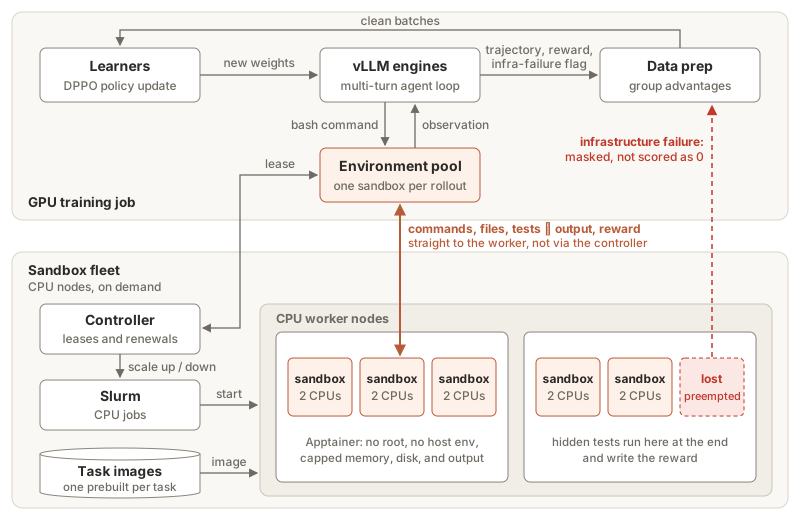
- Separate nodes for sandboxes. Sandboxes run on CPU nodes that the controller requests from Slurm on demand and releases when idle, so they no longer compete with inference for CPU, memory, and disk. Each rollout holds one 2-CPU sandbox lease. Leases expire unless renewed, and lost or orphaned sandboxes are cleaned up, so a multi-day run does not slowly leak capacity.
- Prebuilt task images. We build and check one image per task before training starts, so nothing is pulled from a registry mid-run. A missing image is flagged as an error.
- Masking infrastructure failures. When a sandbox’s worker disappears or the sandbox stops running mid-episode, the rollout is flagged as an infrastructure failure. The trainer drops flagged rollouts and computes advantages from the rest of the group, skipping any group left with fewer than two valid rollouts. Failures the policy causes, like running out of memory, still score 0. If a sandbox can’t be set up at all, the run stops rather than train without it.
- Rollout time limits. A rollout’s time budget starts once it holds a sandbox, not while it waits in the queue. A command that times out comes back to the agent as an observation instead of ending the episode.
A 1,000-step run on the sandbox fleet. Qwen3.5-9B trained with the v1.0 recipe on the v1.0 data (DPPO, FP32 LM head, 8 prompts × 32 rollouts per step). Switch metrics to see that entropy, gradient norm, and the logprob gap between vLLM and the learner stay flat while the solve rate keeps rising. One seed, resumed twice after crashes.
With the same recipe and data as v1.0, training now runs to 1,000
steps without collapsing. The same fleet also runs our TB Lite and TB
2.1 evaluations, at a fraction of the cost of a hosted sandbox
service.These evaluations use a fixed subset (96 of 100 TB Lite
tasks, 88 of 89 TB 2.1 tasks), skipping the few tasks that rootless
Apptainer cannot run reliably. Final TB 2.0 numbers still use Daytona
for sandboxes.
Citation
Please cite this work as:
Ivison, Hamish and Yin, Junjie Oscar and Shao, Rulin and Xiao, Teng and
Lambert, Nathan and Hajishirzi, Hannaneh, "Tmax: A simple recipe for terminal
agents", arXiv preprint arXiv:2606.23321, 2026.
Or use the BibTeX citation:
@misc{ivison2026tmaxsimplerecipeterminal,
      title={Tmax: A simple recipe for terminal agents},
      author={Hamish Ivison and Junjie Oscar Yin and Rulin Shao and Teng Xiao and Nathan Lambert and Hannaneh Hajishirzi},
      year={2026},
      eprint={2606.23321},
      archivePrefix={arXiv},
      primaryClass={cs.CL},
      url={https://arxiv.org/abs/2606.23321},
}